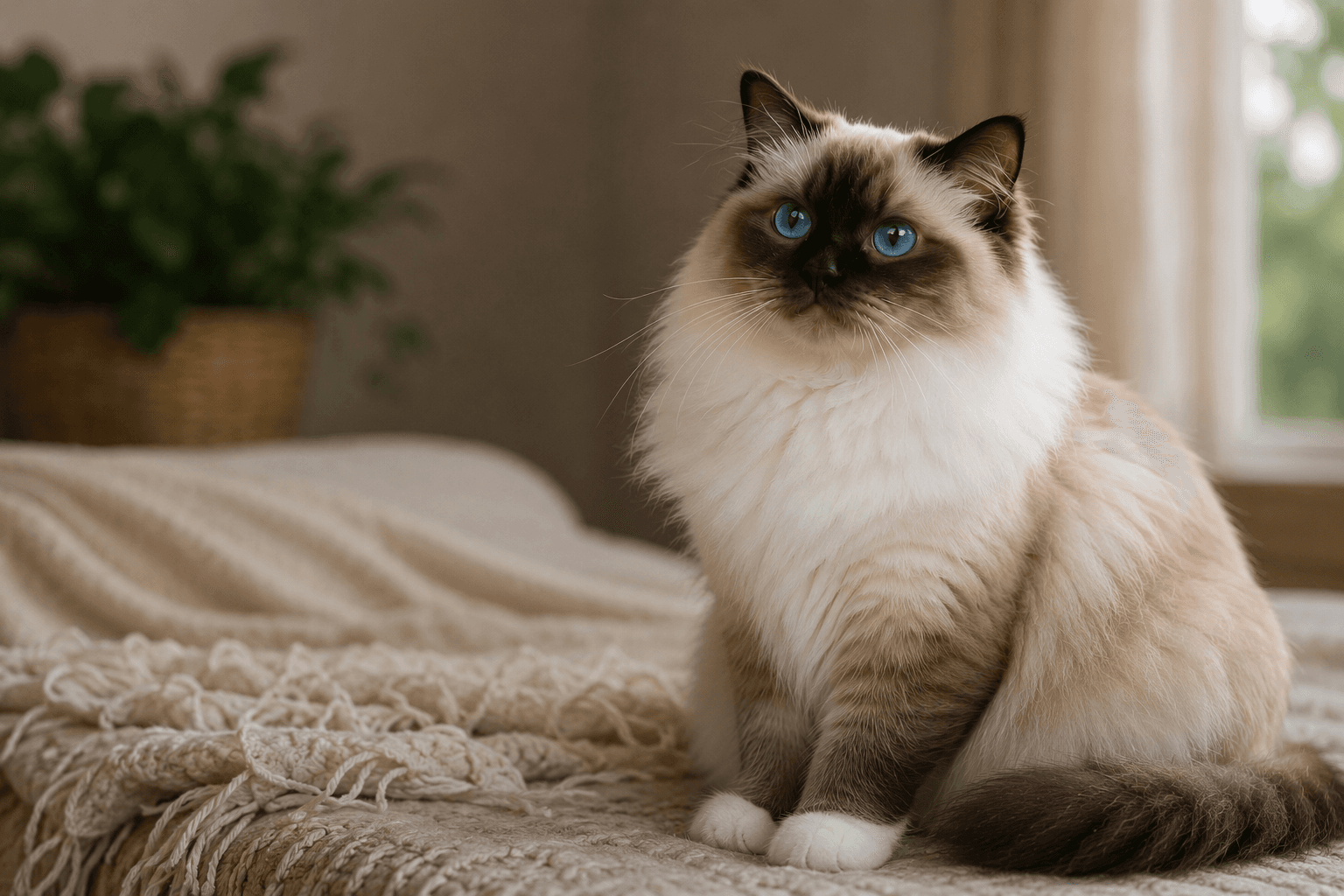

Introducing a New Breed
Sacred Beauty,
Gentle Soul
A graceful blend of the Sacred Birman and the Ragdoll — combining silky coats, sapphire-blue eyes, and an irresistibly gentle temperament.
Meet the Breed
What is a Birmadoll?
A carefully developed hybrid that inherits the very best of two iconic and deeply loved breeds.
The Birmadoll is an exciting and carefully developed hybrid cat breed that results from crossing the beloved Ragdoll with the ancient and mysterious Sacred Birman (also known as the Sacred Cat of Burma). The combination brings together two breeds that are already closely related in spirit — both known for their silky semi-long coats, mesmerising blue eyes, pointed colour patterns, and extraordinarily gentle temperaments.
Interestingly, the Ragdoll itself is believed to have Birman ancestry in its founding bloodlines, making the Birmadoll a fascinating reunion of two kindred spirits. Breeders working with this cross aim to produce cats that carry the dreamy size and plush coat of the Ragdoll, paired with the signature white gloves and slightly more refined features of the Sacred Birman.
As a new and emerging breed, the Birmadoll is still being shaped and refined by dedicated breeders across Europe. Though not yet officially recognised by major cat registries as a standalone breed, the Birmadoll is generating tremendous enthusiasm among cat lovers who seek a companion that is both strikingly beautiful and deeply affectionate.
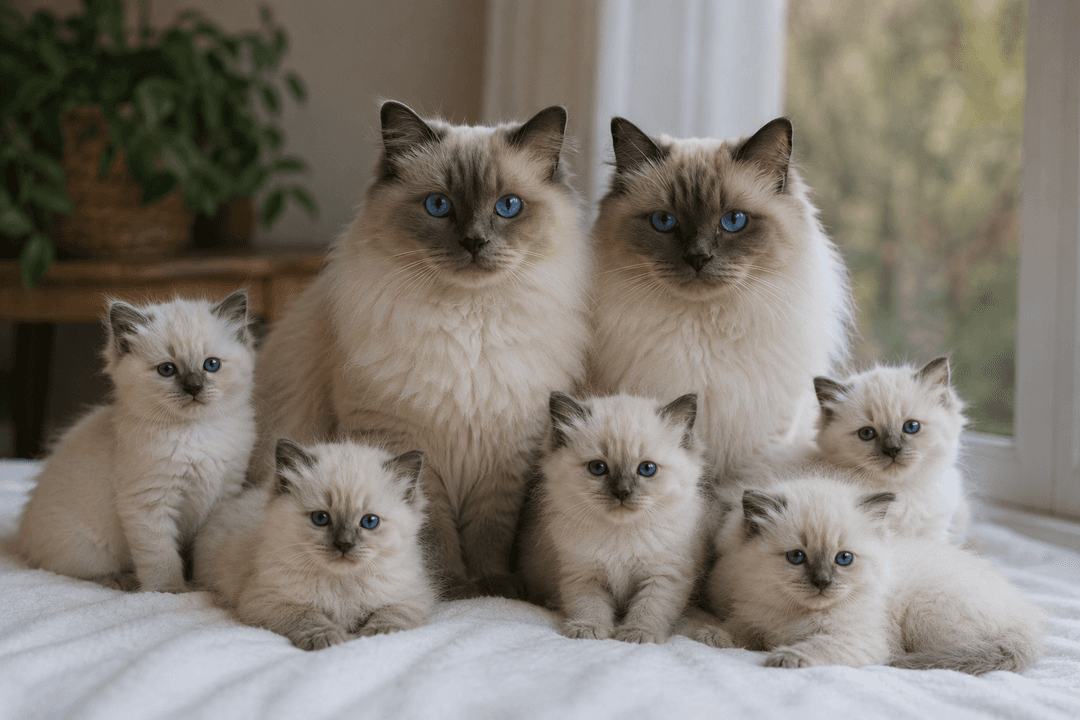
Deep Blue Eyes
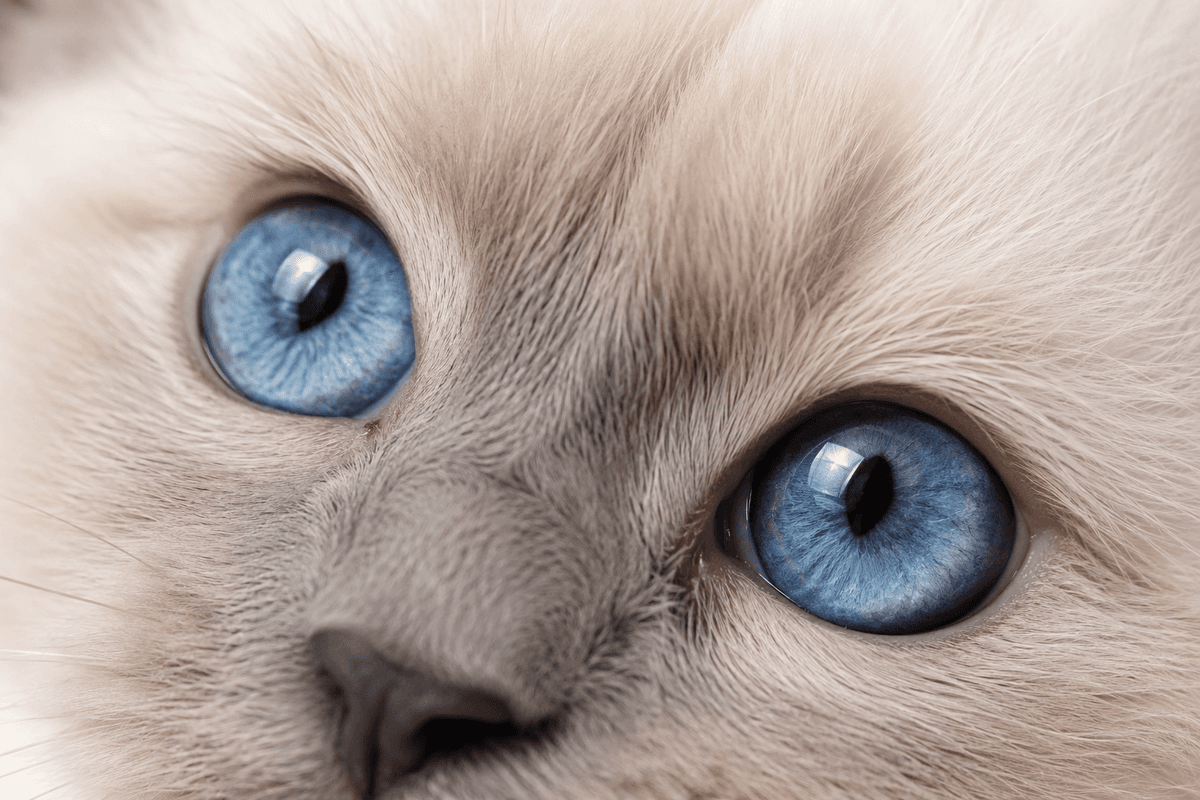
Vivid, ocean-deep blue eyes inherited from both parent breeds — a defining and captivating feature.
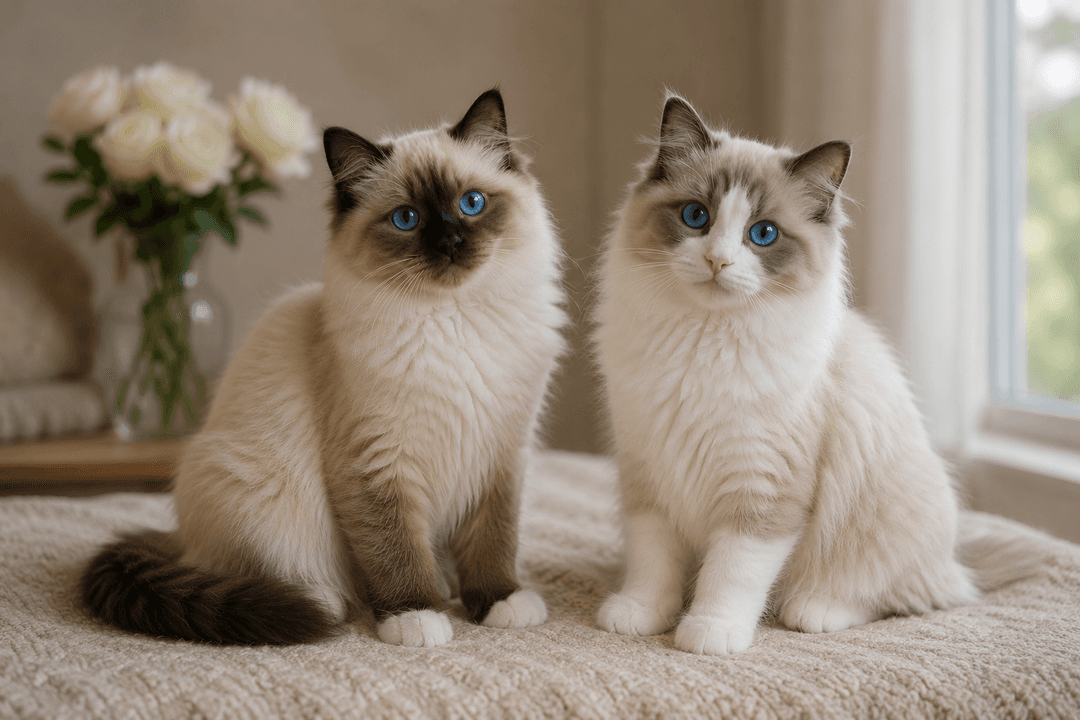
White Gloves
Classic white paw markings from the Sacred Birman, a legendary trait that sets this breed apart.
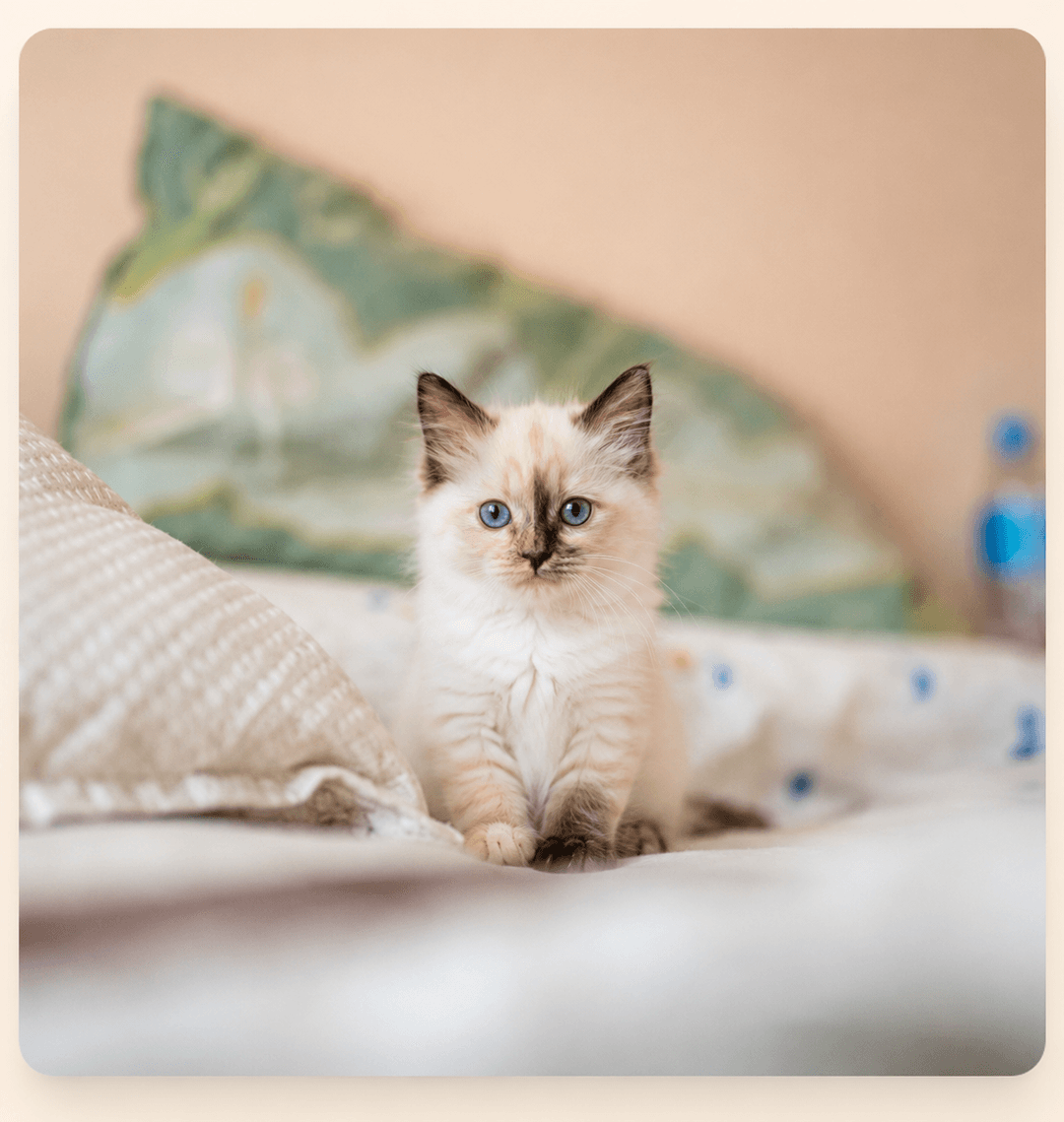
Gentle Giant
Large, soft-bodied build from the Ragdoll side — these cats are big, plush, and absolutely huggable.
People Devoted
Extraordinarily affectionate and loyal — Birmadolls follow their family everywhere and thrive on love.
Parent Breed I
The Ragdoll: California's Gentle Giant
From a mysterious neighbourhood cat in 1960s Riverside to one of the world's most beloved breeds.
The Birth of a Legend
The Ragdoll story begins in the early 1960s in Riverside, California, with a woman named Ann Baker — a Persian cat breeder with a passion for extraordinary felines. Her neighbour owned a colony of semi-feral cats living on her property, and among them was a white, long-haired female of Angora type named Josephine. Josephine was unusual: her kittens consistently displayed remarkable docility, going limp when held like a ragdoll, with an almost dog-like tolerance for being picked up and carried.
Ann Baker was fascinated. She began acquiring kittens from Josephine's litters and carefully selecting those with the most gentle, pliant temperaments and beautiful point colouration. Whether Josephine had Birman or Persian ancestry in her background remains debated to this day, but the results of Ann's careful selection programme were undeniable: cats of extraordinary beauty and equally extraordinary gentleness.
Foundation Cats
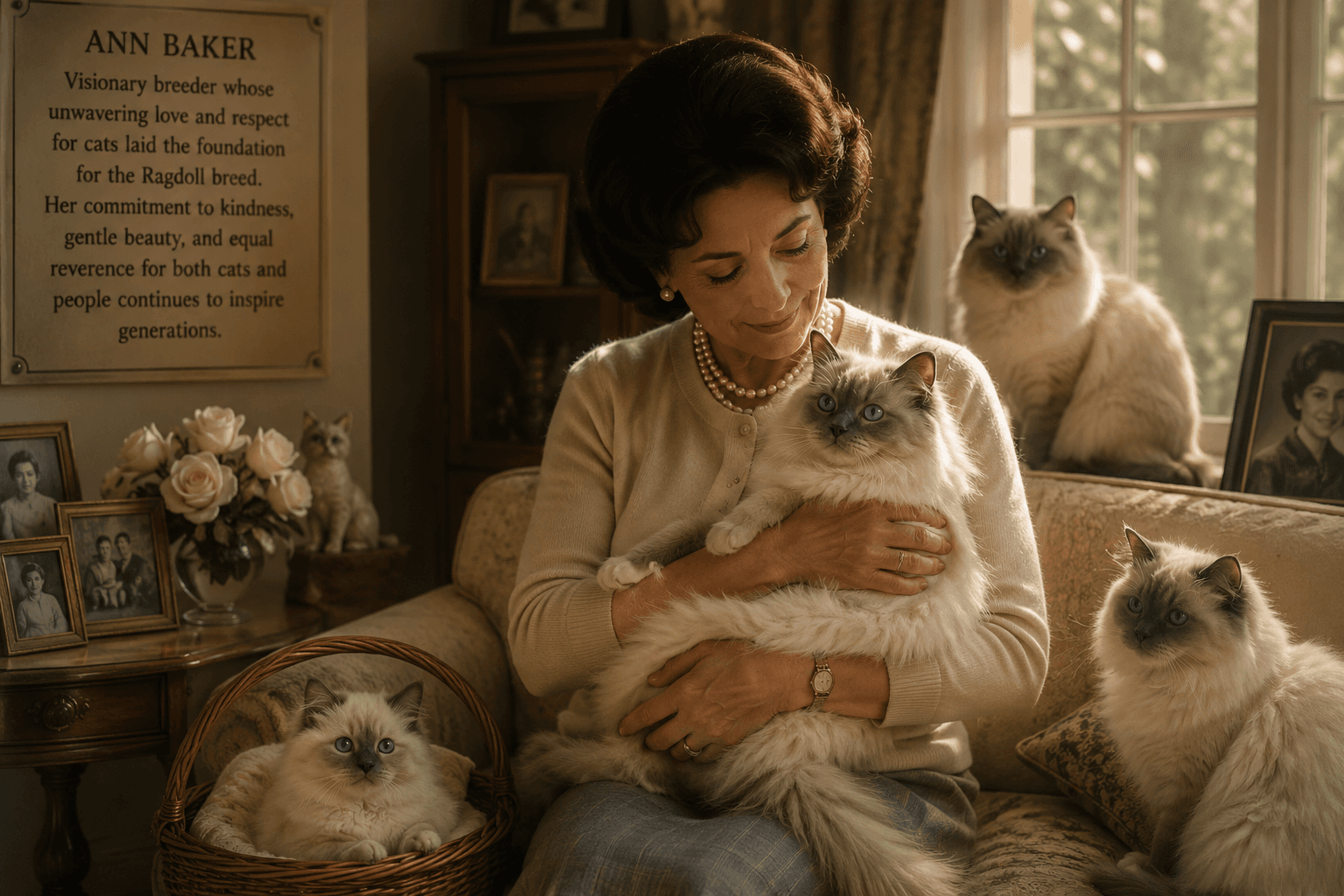
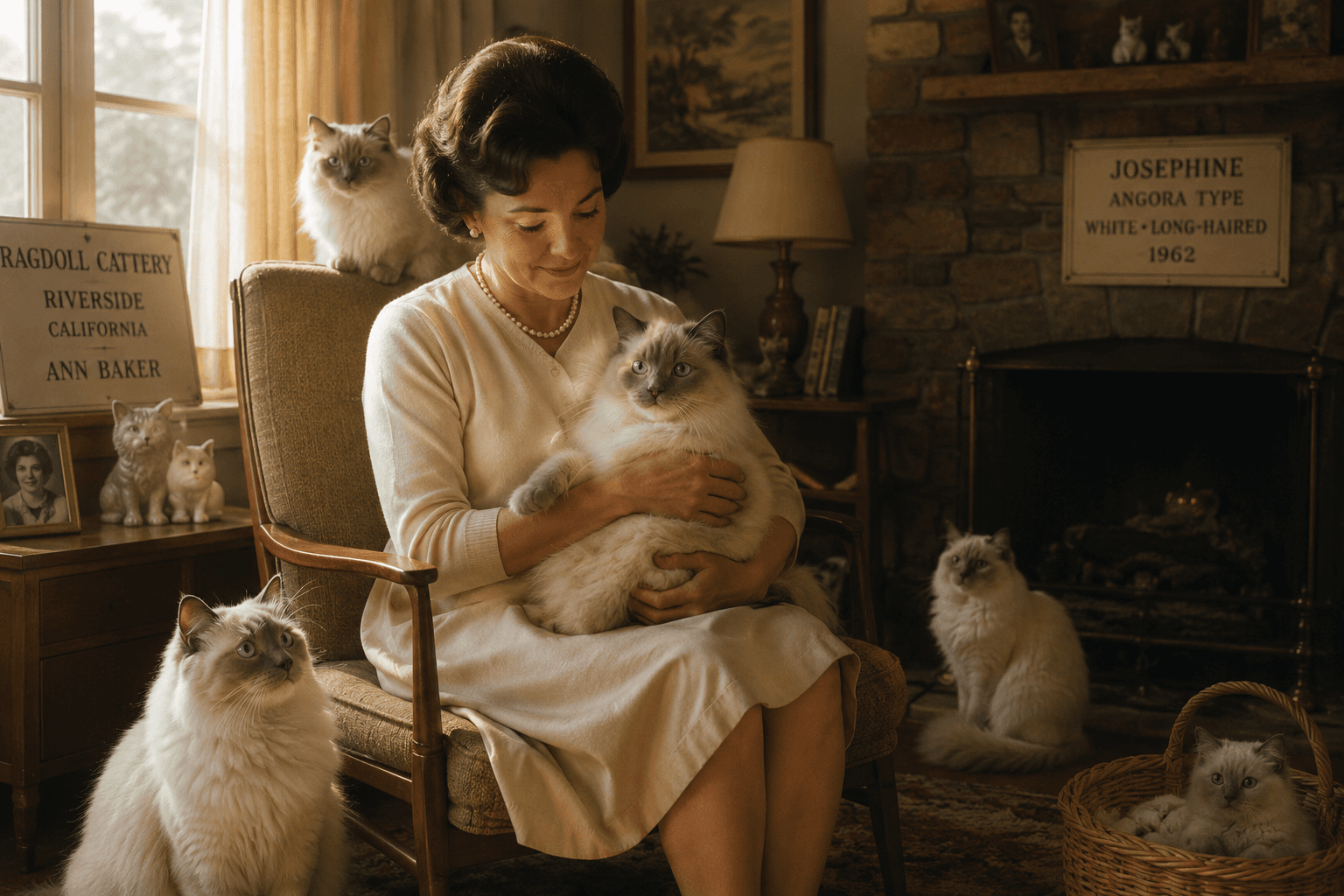
Ann Baker begins her selective breeding programme in Riverside, California, working with Josephine's offspring.
The Ragdoll is officially registered — Daddy Warbucks, Fugianna, Kyoto, and Tiki become the first registered Ragdolls with NCFA.
Ann Baker trademarks the name 'Ragdoll' and establishes IRCA with strict franchise licensing rules for breeders.
Ragdolls gain full recognition from TICA and CFA, becoming one of the top five most popular cat breeds worldwide.
Physical Characteristics of the Ragdoll
Size & Build
One of the largest domestic cat breeds. Males typically weigh 6.8–9 kg (15–20 lbs), females 4.5–6.8 kg (10–15 lbs). Broad chest, heavy bone structure, substantial muscular body. Full maturity is not reached until 3–4 years of age.
Coat
Semi-long, silky, rabbit-like fur that lies flat against the body and does not mat as easily as many long-haired breeds. Thicker at the ruff, tail, and hind legs. Minimal undercoat reduces shedding compared to other long-haired breeds.
Eyes & Head
Oval-shaped, vivid blue eyes are a breed standard requirement. The head is broad and flat-topped, with full cheeks, a medium-length muzzle, and a strong chin. Ears are medium-sized, set wide apart with a slight forward tilt.
Parent Breed II
The Sacred Birman: Legend of Burma
One of the oldest and most mystical cat breeds — born in the temples of ancient Burma and refined in the salons of France.
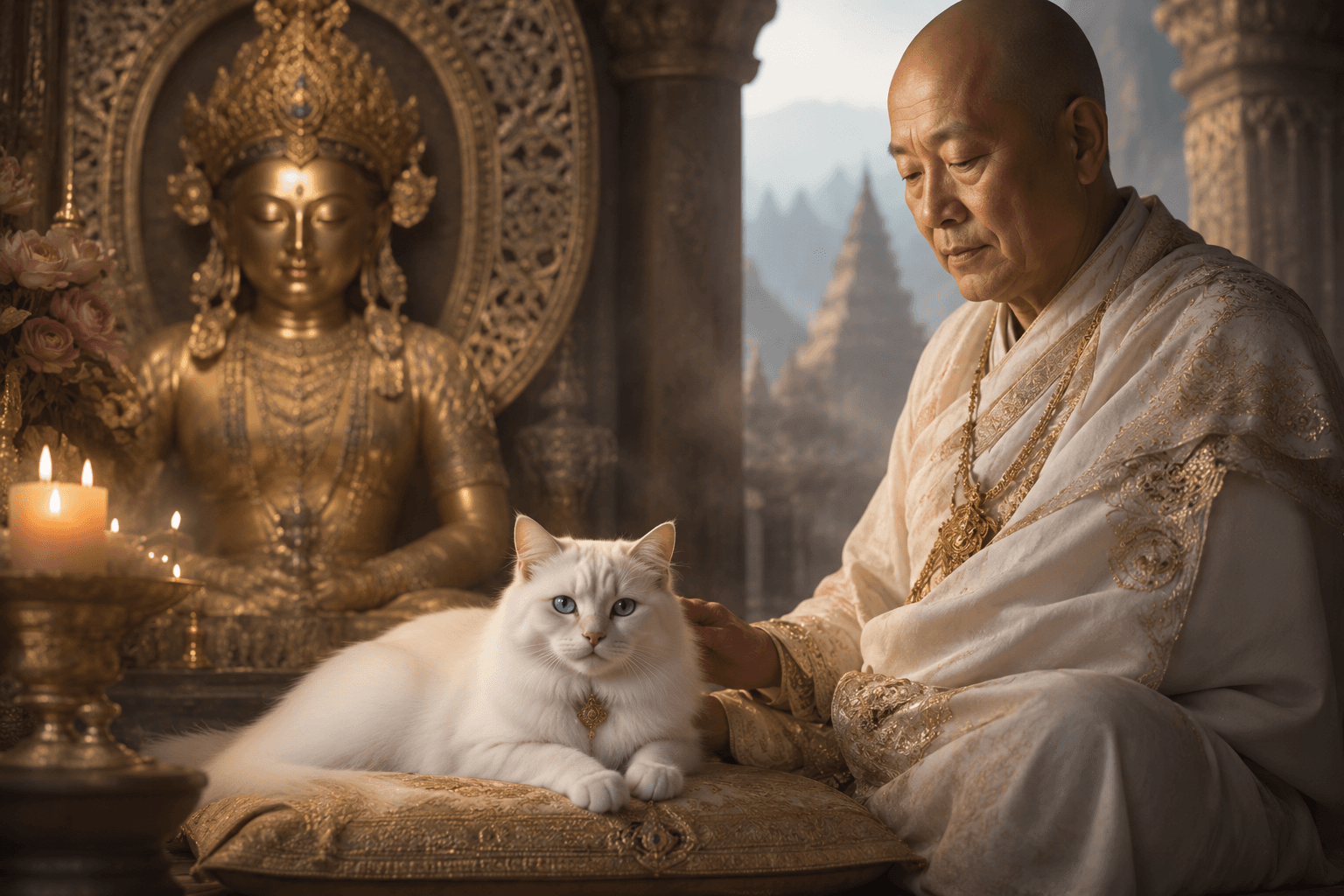

The Legend of the Temple Cats
According to ancient Burmese legend, the Sacred Birman was the companion of the Kittah priests at the temple of Lao-Tsun, high in the mountains of Burma. A golden goddess with sapphire-blue eyes, Tsun-Kyan-Kse, was said to preside over the transformation of souls. The head priest Mun-Ha kept a beautiful white cat named Sinh who would sit beside him during his nightly prayers.
One night, raiders attacked the temple and Mun-Ha was struck down. As his soul departed, Sinh placed his paws upon his fallen master and faced the goddess. In that moment, the cat's white fur was bathed in a golden glow, his yellow eyes turned a deep sapphire blue to mirror those of the goddess, and his paws — where they touched the priest's white hair — remained white forever as a symbol of purity.
Seven days later, Sinh died, carrying Mun-Ha's soul to paradise. When the priests gathered to choose a new leader, all the remaining white temple cats had been transformed — coloured points, golden shimmer, and those legendary white gloves. This legend endures to this day, and the white gloves on the Birman's paws remain the breed's most defining characteristic.
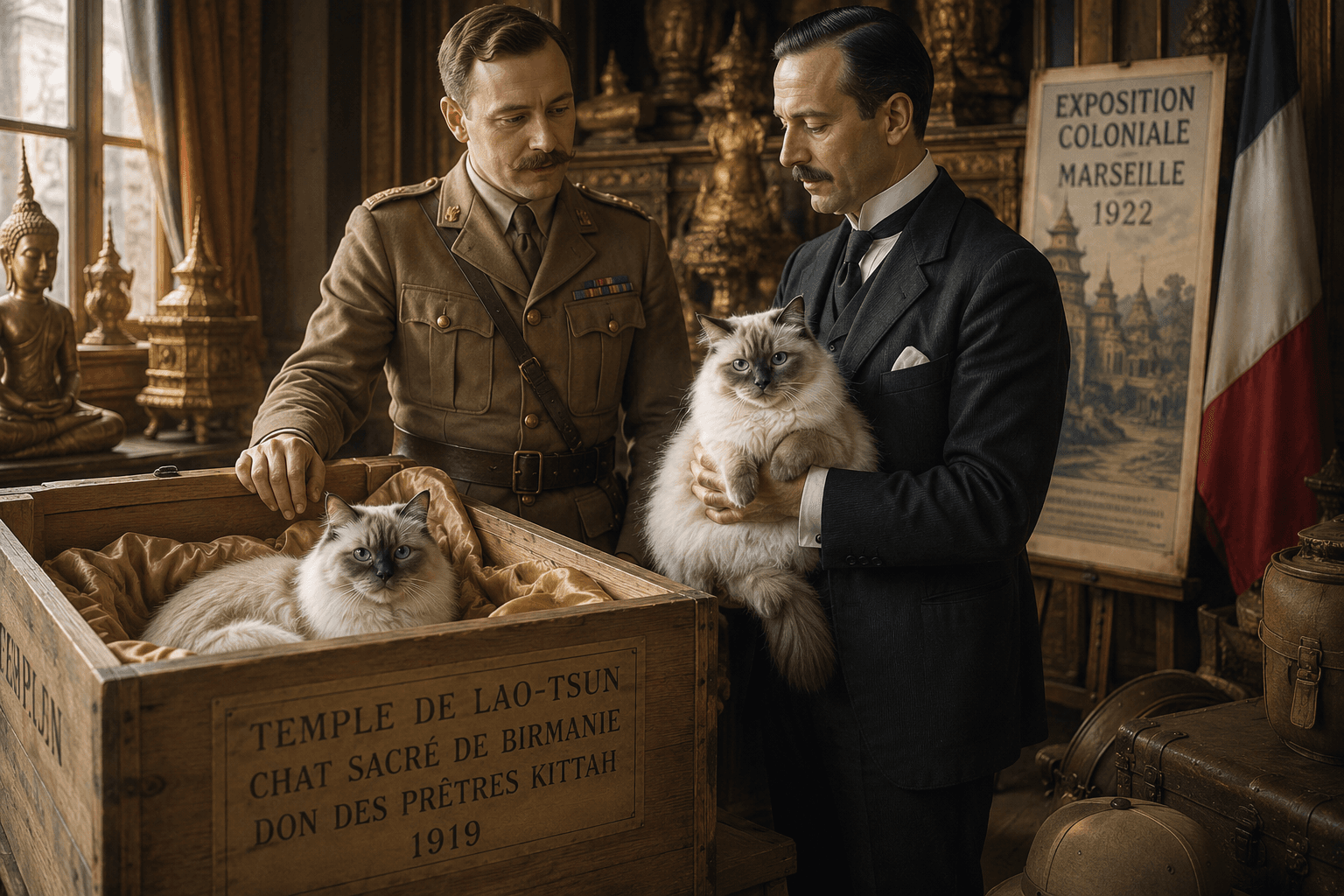
From Burma to France
The historical record of how the Birman arrived in Europe is somewhat clouded in mystery, which suits a breed of such legendary origin. The most widely accepted account involves two Frenchmen — Major Gordon Russell and Auguste Pavie — who are said to have received a pair of sacred temple cats as a gift of gratitude from the Kittah priests in 1919, in recognition of their assistance in protecting the temple during a period of unrest.
The male did not survive the journey, but the pregnant female — named Sita — arrived safely in France. The kittens she produced became the foundation of European Birman breeding. The breed was officially recognised in France in 1925, and the name "Birman" derives from Birmanie, the French word for Burma.
Near Extinction & The Great Revival
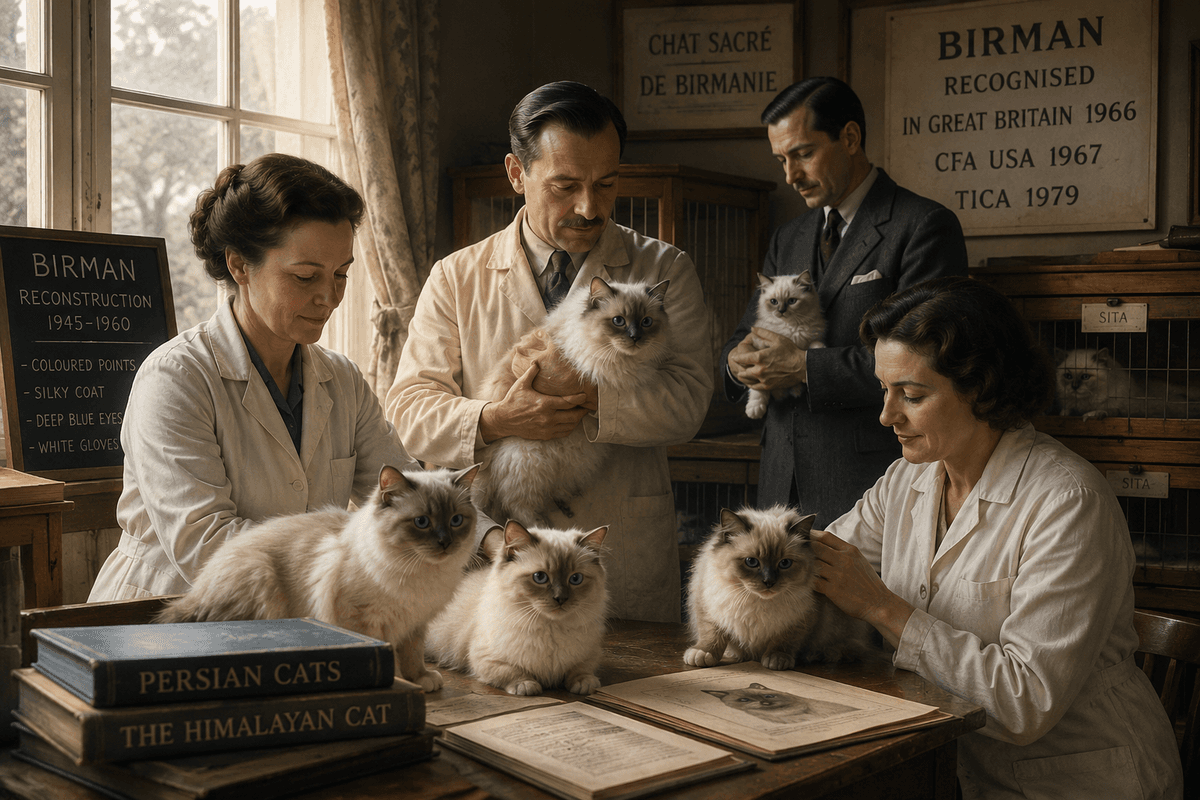
The Second World War almost erased the Birman from existence entirely. By 1945, after the devastating years of German occupation of France and the chaos of wartime Europe, the Birman population had been virtually annihilated. According to some accounts, as few as two catssurvived the war — a number so perilously small that the breed's future was genuinely in doubt.
A small group of dedicated French breeders took up the enormous challenge of reconstructing the breed through careful outcrossing with compatible long-haired breeds — believed to include Persians and possibly early Himalayans — while striving to maintain the essential characteristics: coloured points, silky coat, deep blue eyes, and the sacred white gloves.
By the late 1950s and 1960s, the Birman had been successfully rebuilt. It received recognition in Britain in 1966, was accepted by the CFA in the USA in 1967, and gained TICA recognition in 1979.
The White Gloves
The breed's most iconic feature. All four paws must bear pure white markings — symmetrical 'gloves' on the front feet, and longer 'gauntlets' on the rear that taper to a point up the back of the leg. A Birman without correct gloves is not considered a true representative of the breed.
Sapphire Blue Eyes
Deep, luminous blue eyes are an absolute breed requirement. The shade should be as rich and vivid as possible — described as 'sapphire blue' — and is linked to the colour-point genetics that give the breed its characteristic pattern.
Silky Coat
A semi-long, single-layer coat of fine, silky texture that does not mat as readily as double-coated long-haired breeds. The coat has a slight wave near the belly and a full ruff around the neck. Lighter and less plush than the Ragdoll's coat.
Coat & Appearance
Patterns, Colours & Markings
The Birmadoll inherits a stunning palette from both parent breeds — resulting in breathtaking coat combinations.
Because both the Ragdoll and the Sacred Birman are colour-point breeds — their coat is lighter on the body and darker on the face, ears, legs, and tail — the Birmadoll will almost always display some form of colour-point pattern. Both parent breeds carry this recessive gene, meaning virtually all Birmadoll kittens will be colour-pointed.
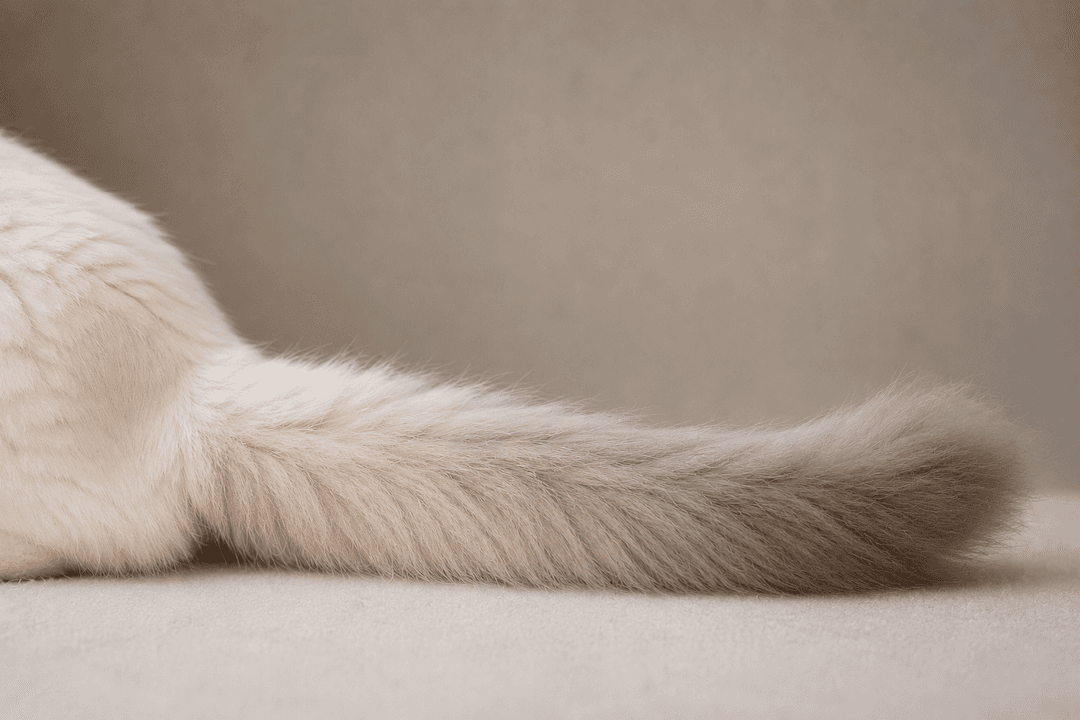
The Birmadoll coat is typically semi-long to long, silky, and plush — often slightly denser than a pure Birman's coat due to Ragdoll influence, but lighter and less prone to matting than a pure Ragdoll. Expect a full neck ruff, feathered ears, a gloriously plumed tail, and tufted toes.
One of the most eagerly anticipated traits in Birmadoll breeding is the possibility of inheriting the Sacred Birman's legendary white glovesalongside the Ragdoll's larger, more dramatic build. When this combination appears, the result is truly extraordinary.
Expected Coat Patterns
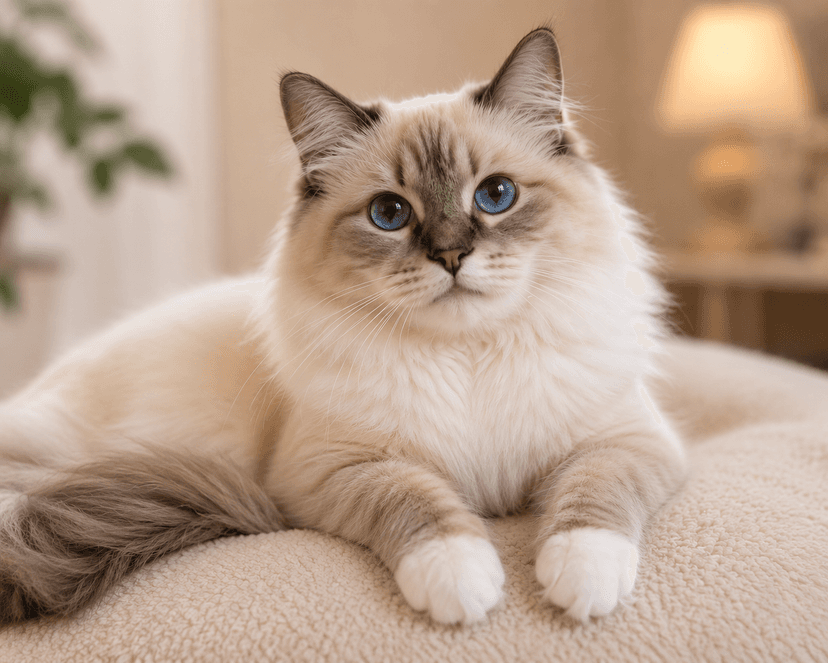
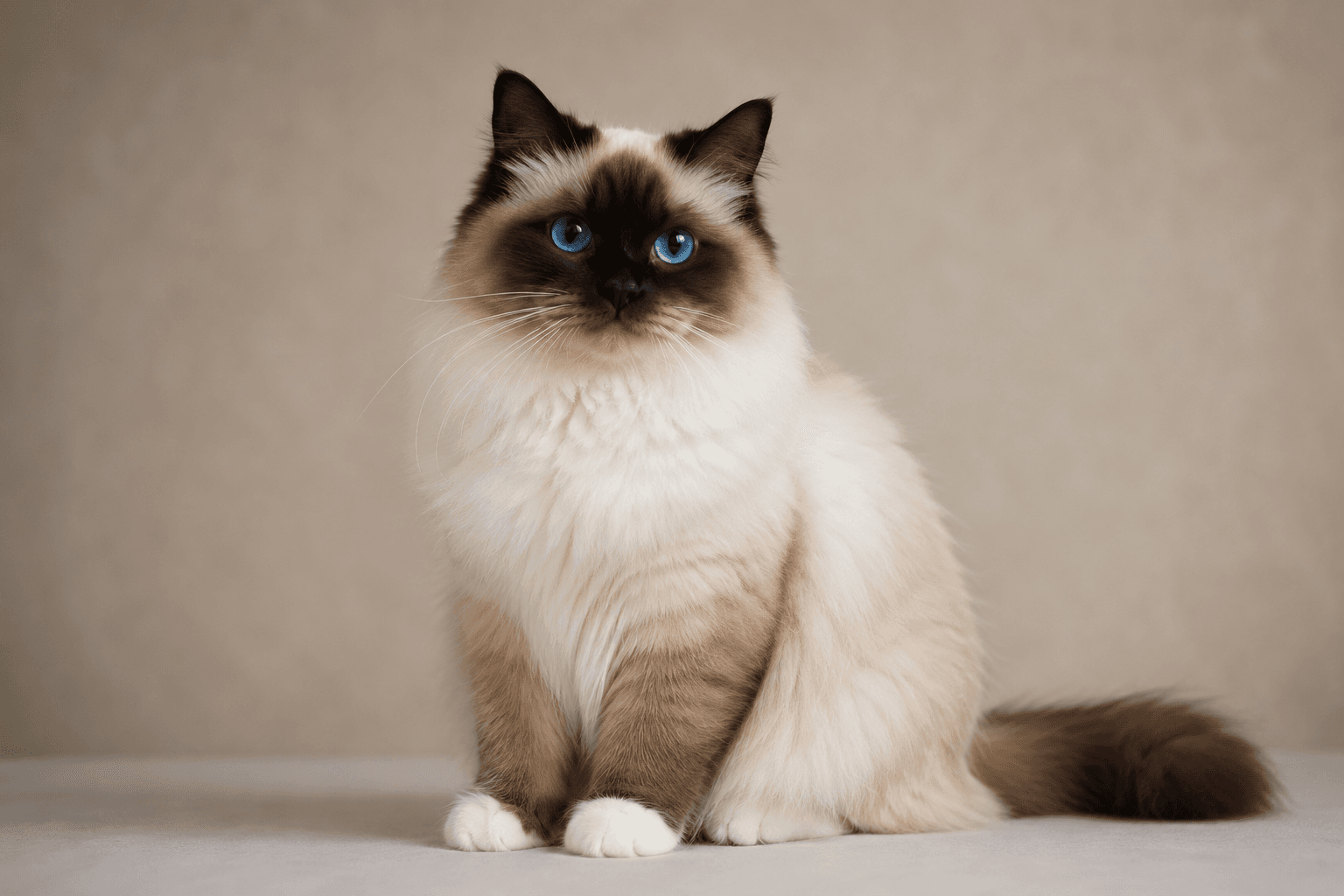
Colourpoint
The classic pattern: creamy or white body with dark, richly saturated points on the face mask, ears, legs, and tail. No white markings. The most common pattern seen in both parent breeds.
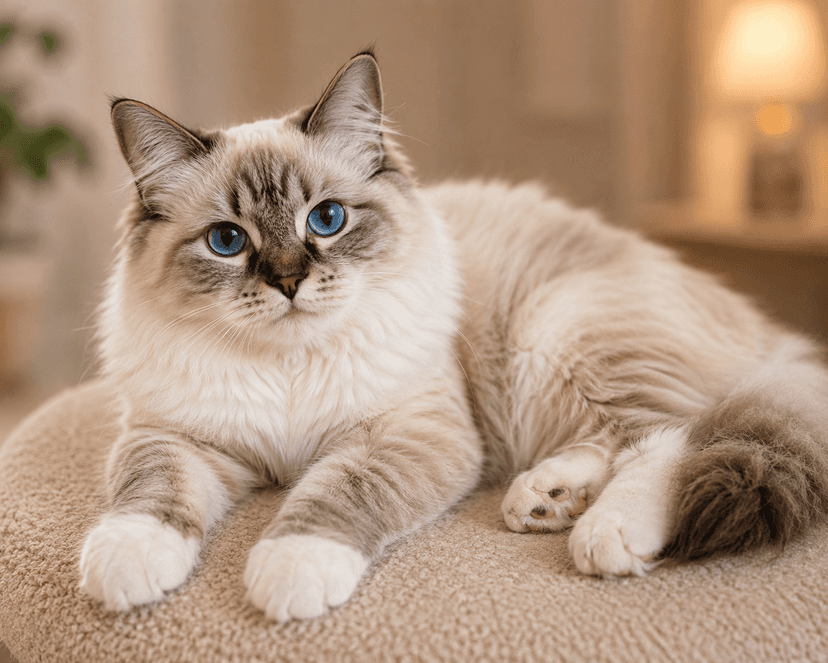
Mitted
Colourpoint pattern plus white chin, chest stripe, belly, and white mittens on the front paws. Sometimes features a white blaze or star on the forehead. Brings the Birmadoll closest to Birman glove markings.
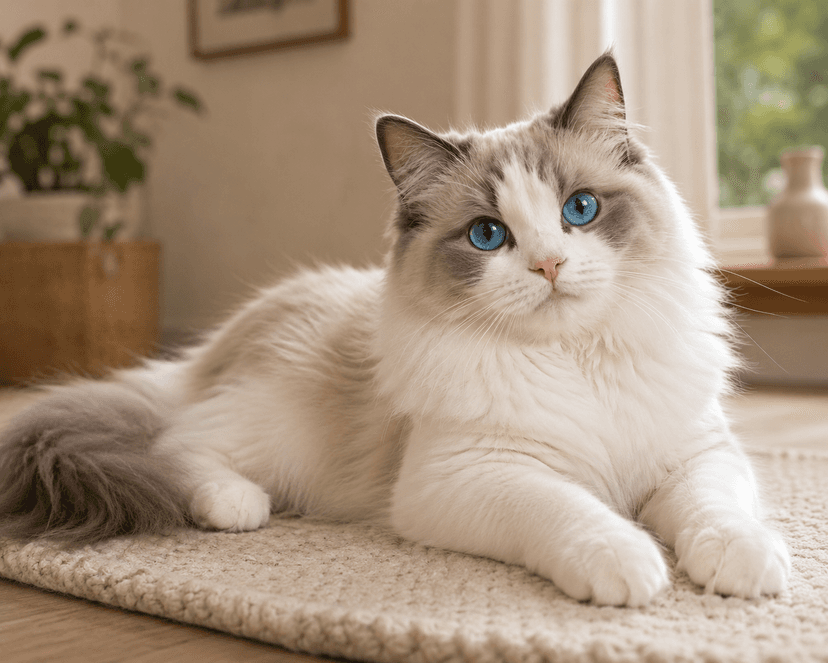
Bicolour
A white inverted V blaze on the face, white belly, all four white legs, and white patches. Body retains colour-point markings. Creates a dramatic, two-toned appearance inherited from the Ragdoll.
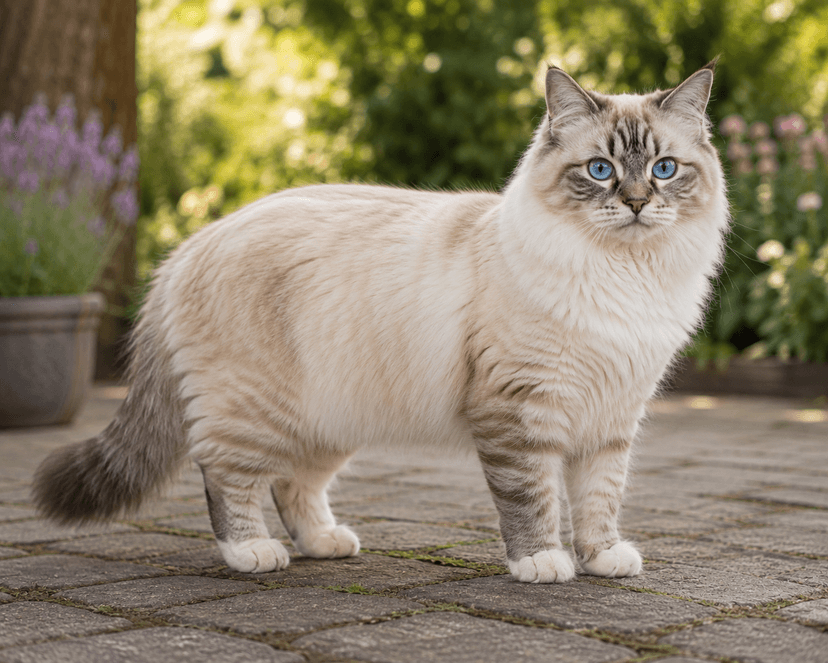
Lynx (Tabby Point)
Tabby striping added to the colour points, appearing in any of the above patterns. Creates a gentle, tiger-like striping on the face, ears, and legs while the body remains light.
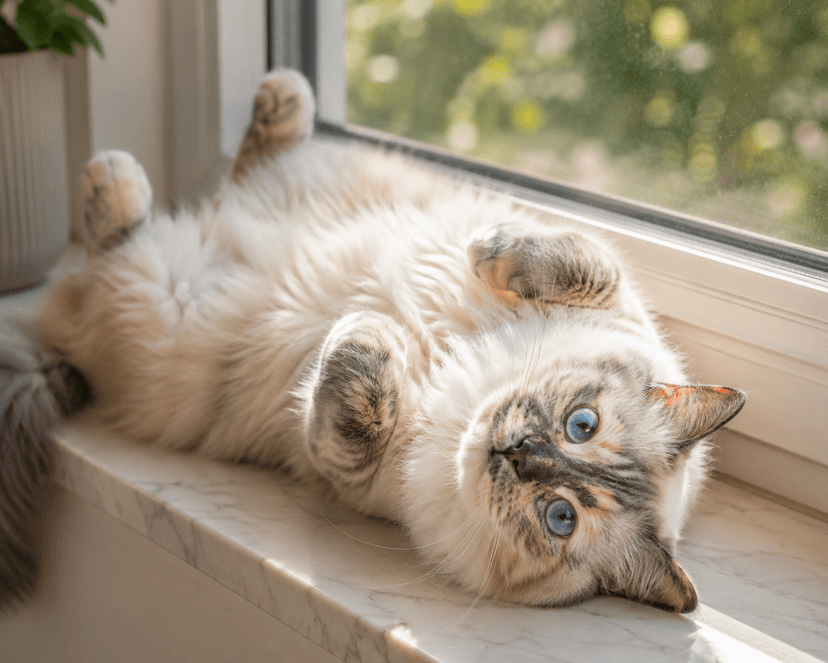
Tortie Point
A combination of two colour genes creating a mosaic, patchy effect on the points. Almost exclusively seen in female cats. Can combine with lynx to create torbie patterns.
2.png&w=828&q=75)
Gloved (Birman Heritage)
One of the most prized outcomes — inheriting the Sacred Birman's symmetrical white gloves on all four feet while carrying Ragdoll-sized build and coat. The breed's ideal when gloves are correct and symmetrical.
Point Colours
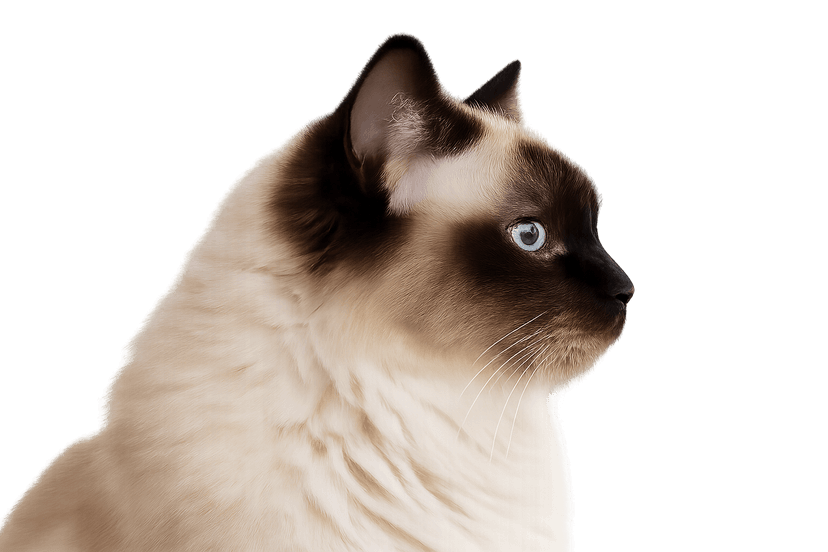
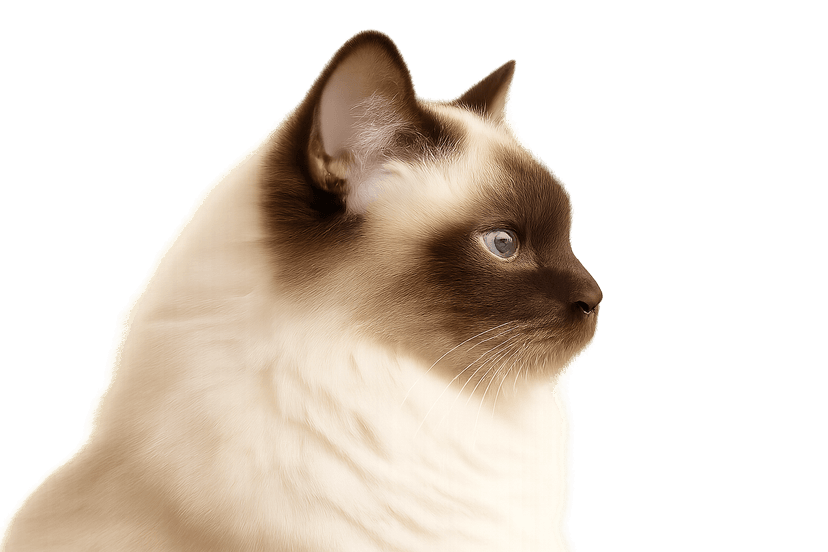
Seal
Deep dark brown, almost black
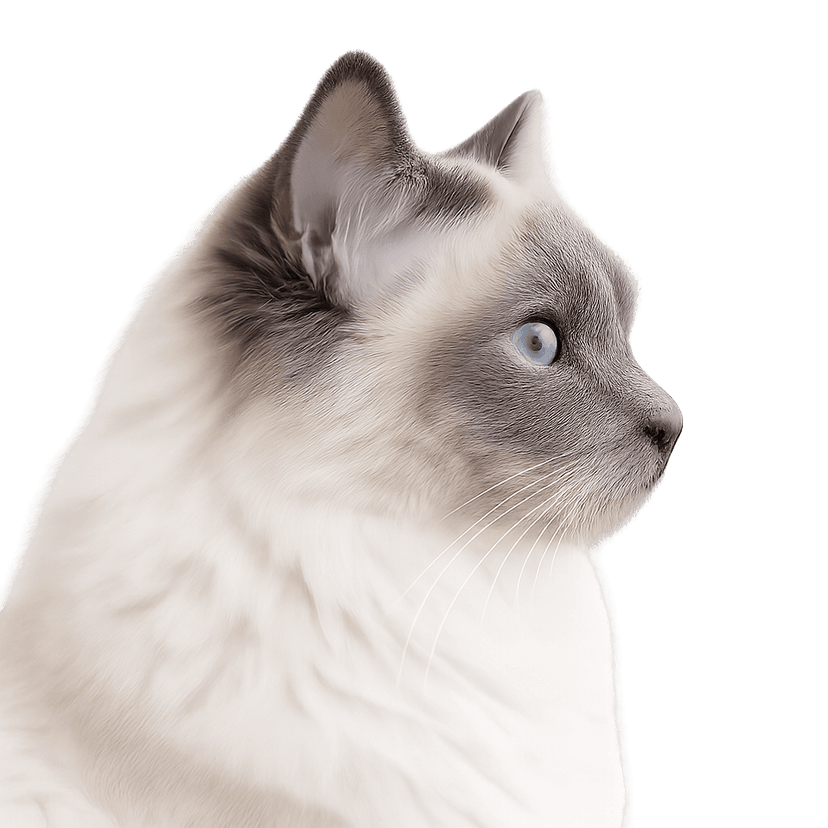
Blue
Cool blue-grey, diluted seal
Chocolate
Warm milk-chocolate brown
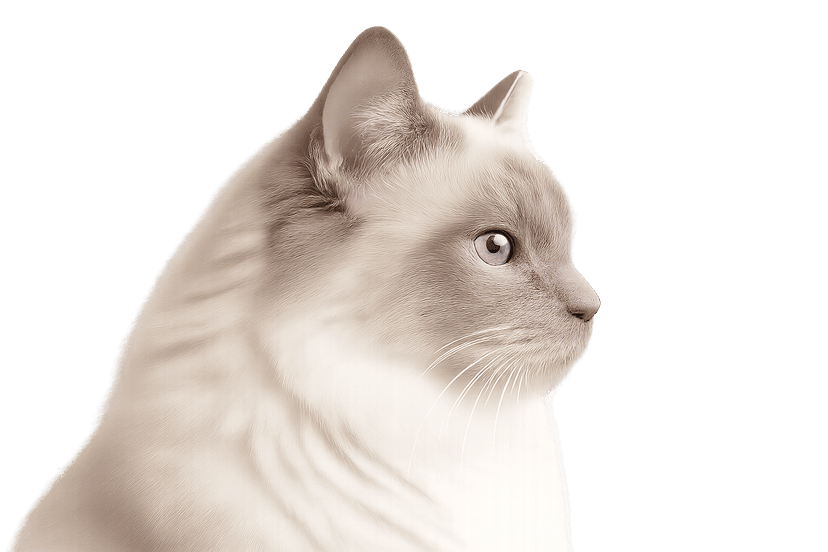
Lilac
Pale pinkish-grey, diluted chocolate
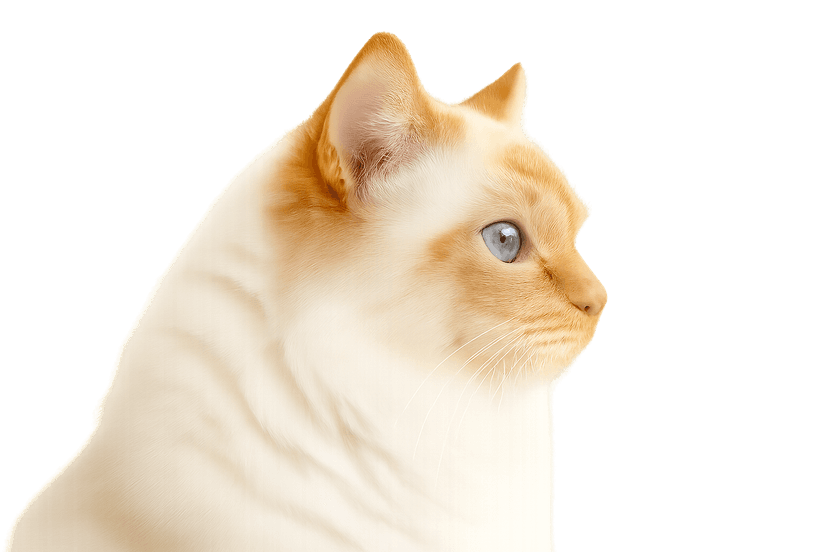
Red / Flame
Warm orange-red tones
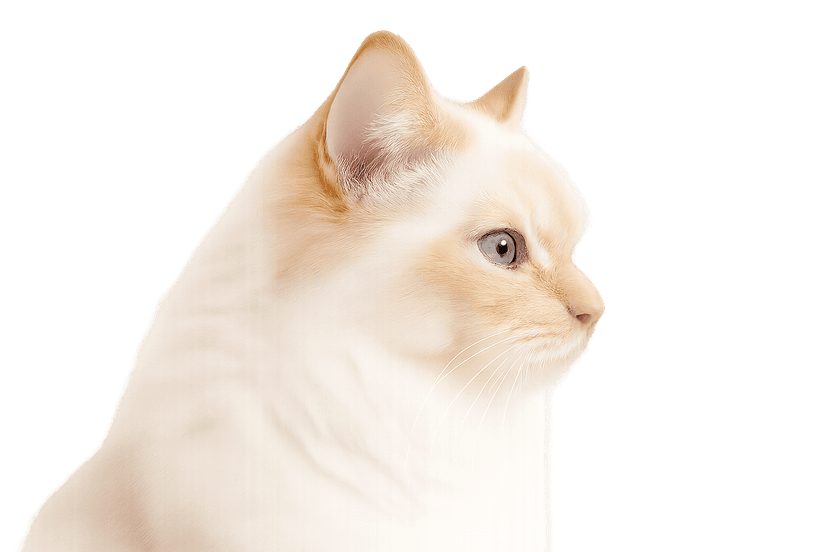
Cream
Pale buff, diluted red
Personality & Character
Life with a Birmadoll
Sweet, devoted, calm and playful — the Birmadoll is designed to be the perfect family companion.
With the Family
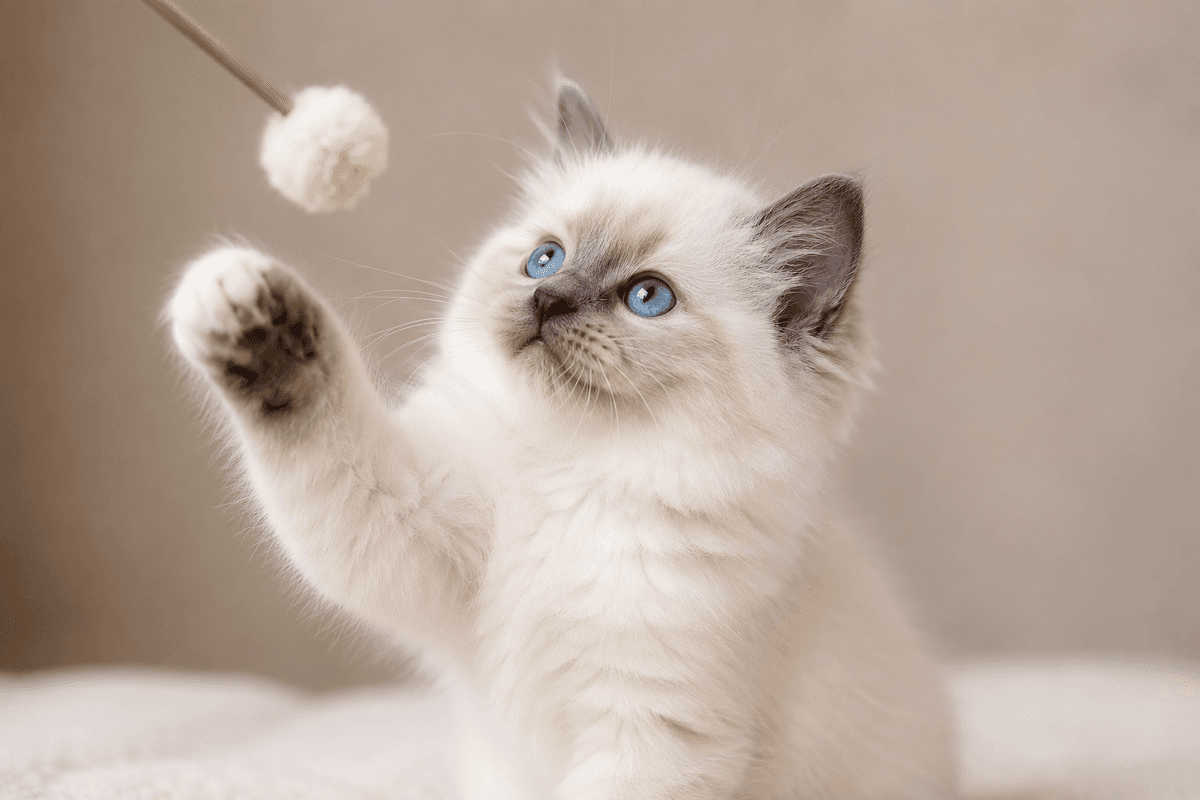
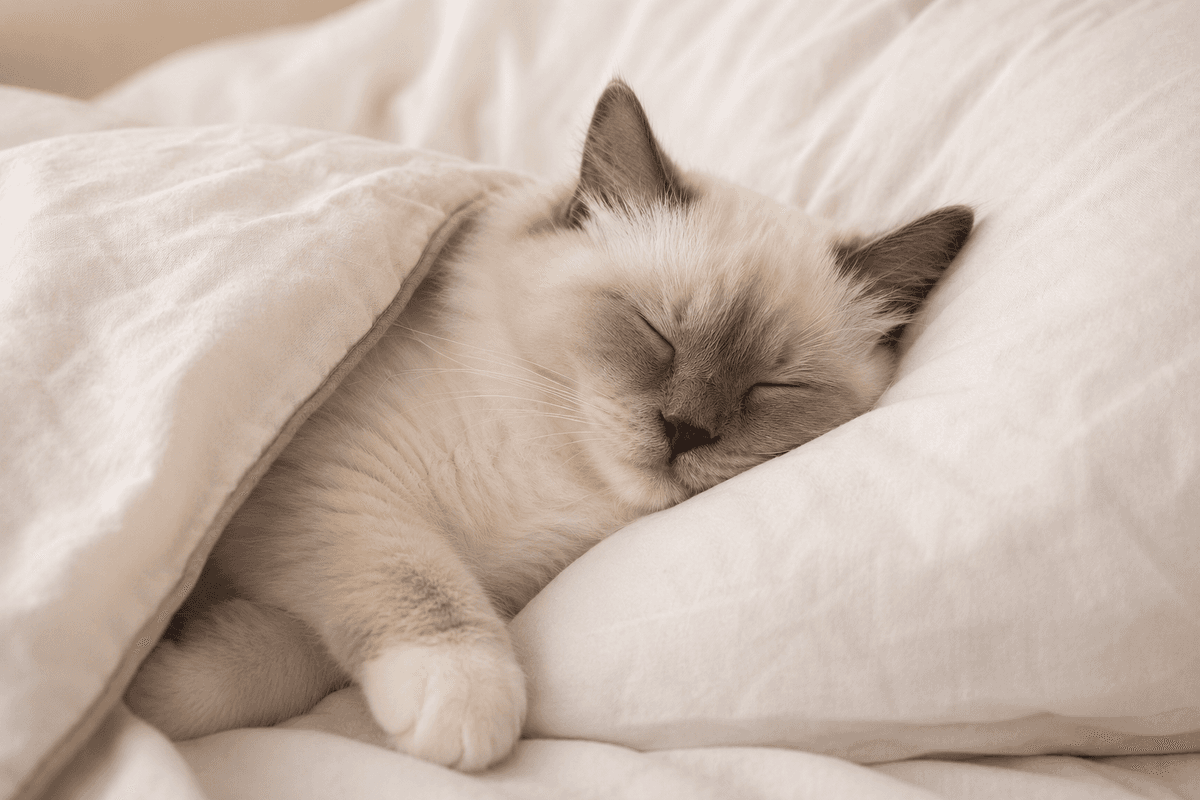
Birmadolls are profoundly people-oriented cats. They form deep, lasting bonds with their human family and are known to follow their favourite person from room to room, offering quiet, steady companionship throughout the day. Like their Ragdoll parent, they often go limp when picked up — tolerating and even enjoying being held and cuddled in ways that many other cats would never accept. They are genuinely happiest when part of family life, joining in on daily routines, sitting beside you on the sofa, and sleeping near — or on — their people at night.
With Children
Few breeds are as naturally suited to family life with children as the Birmadoll. Their extraordinary patience and gentle nature make them tolerant of the enthusiastic, sometimes clumsy affections of young children. They rarely scratch in frustration, preferring to simply walk away if overstimulated. Both parent breeds score extremely highly for child-friendliness, and the Birmadoll inherits this quality in full. Older children who learn to respect the cat's boundaries will find a devoted, interactive playmate who enjoys gentle games and lounging together for hours.
With Other Animals
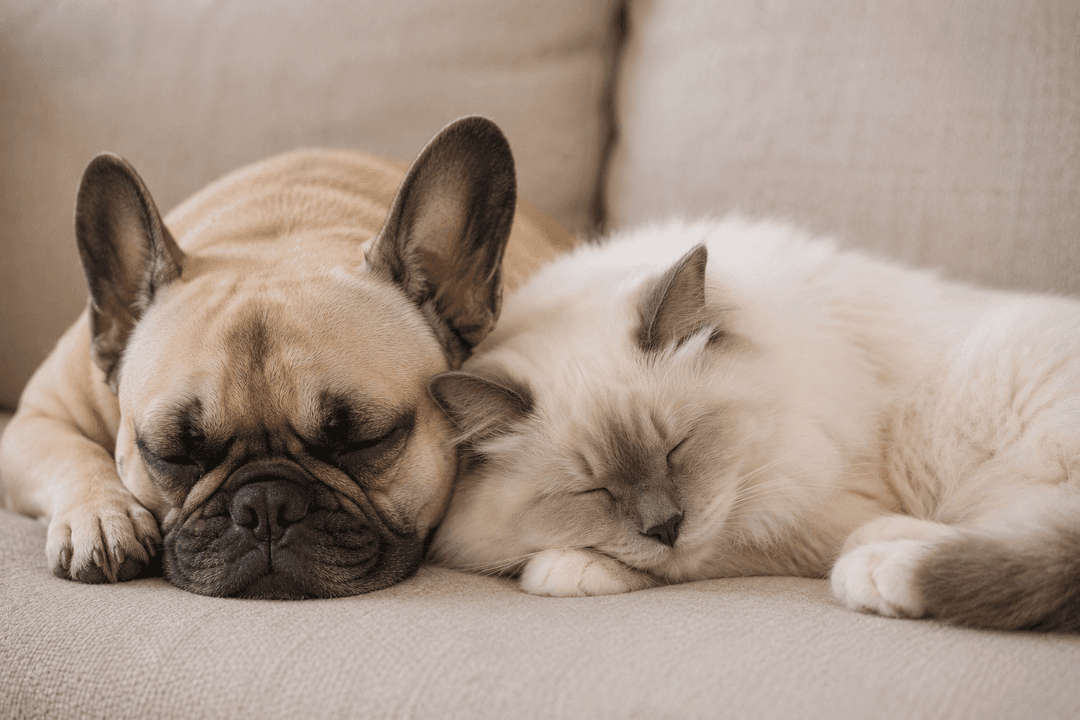
Birmadolls adapt remarkably well to multi-pet households. Both parent breeds are noted for their calm, non-aggressive approach to other animals, and the Birmadoll carries this trait with distinction. They will typically accept a resident dog — particularly a calm or cat-friendly breed — with curiosity rather than fear or hostility. With other cats, they are usually friendly and social, though introductions should always be gradual. Their non-territorial, easy-going nature makes them much less likely to instigate conflict than more assertive breeds.
The Birmadoll Personality in Detail
Calm & Non-Demanding
Unlike vocal breeds such as the Siamese, Birmadolls communicate softly and rarely demand attention loudly. They make their presence known through gentle touch and quiet proximity rather than insistent vocalisation.
Playful & Intelligent
Behind the serene exterior is a curious, playful mind. Birmadolls enjoy interactive toys, puzzle feeders, and games that engage their intelligence. They can learn simple tricks and respond well to positive reinforcement training.
Emotionally Sensitive
These cats are highly attuned to human emotions. They often seek out family members who are upset or unwell, offering comfort through proximity and soft purring. Many owners describe their Birmadolls as having an almost therapeutic presence.
Adaptable
Whether in a busy family home with children and dogs or a quiet apartment with a single owner, Birmadolls adapt gracefully. They tolerate change better than many sensitive breeds, though they always prefer the company of their people to being alone.
Social & Devoted
Birmadolls are not independent cats that happily ignore you. They thrive on connection and can struggle with long periods of solitude. A second pet companion can help if owners work long hours away from home.
Hereditary Health
Health Considerations
Understanding the potential hereditary health challenges of both parent breeds helps Birmadoll owners and breeders ensure the healthiest possible cats.
Hypertrophic Cardiomyopathy (HCM)
Inherited from Both Parent Breeds — High PriorityHCM is the most common heart disease in cats worldwide and is an inherited condition in both the Ragdoll and the Sacred Birman. In HCM, the walls of the heart muscle become abnormally thickened, reducing the heart's efficiency and potentially leading to heart failure, blood clots, or sudden death.
In Ragdolls, a specific DNA mutation (MyBPC3) has been identified and a genetic test is available. Reputable Ragdoll breeders test their breeding cats and can certify HCM-negative status. In Birmans, HCM is also believed to be hereditary, though no specific gene test is yet available; breeders rely on regular cardiac ultrasound (echocardiogram) screening. It is estimated that up to 30% of Ragdolls carry the HCM-associated mutation.
What to do
Always request HCM DNA test results for the Ragdoll parent and echocardiogram records for both parents. Annual cardiac screening of adult Birmadolls is strongly recommended.
Polycystic Kidney Disease (PKD)
Primarily Birman Heritage — TestablePKD causes small, fluid-filled cysts to develop in the kidneys from birth. Over time, these cysts enlarge and multiply, progressively damaging kidney tissue and eventually leading to chronic kidney disease or renal failure. The Sacred Birman is one of the breeds in which PKD has been documented as an inherited condition.
The good news is that PKD is caused by a single dominant gene mutation and a reliable DNA test is available. Cats testing negative (PKD1-negative) cannot develop this form of PKD and cannot pass it to offspring. Responsible breeders will test all Birman parents and provide certificates.
What to do
Request PKD1 DNA test certificates for both parents. Affected cats should never be bred. Regular kidney function blood panels from age 5+ are advisable regardless.
FIP Susceptibility
Ragdoll Heritage — Environmental FactorFeline Infectious Peritonitis (FIP) is a fatal viral disease caused by a mutation of the Feline Coronavirus (FCoV). Ragdolls have been noted in some studies to have a somewhat elevated susceptibility to FIP — possibly due to immune system characteristics. The Birmadoll, inheriting Ragdoll genetics, may carry some of this increased vulnerability.
The disease is not directly inherited but occurs when a common coronavirus mutates inside an individual cat. Minimising FCoV exposure, keeping stress levels low, and maintaining excellent general health are the best preventative measures. Antiviral treatments now offer genuine hope for affected cats.
Urinary & Bladder Issues
Ragdoll Heritage — Dietary ManagementRagdolls have a noted tendency to develop calcium oxalate bladder stones and urinary tract issues. This may be partially inherited by the Birmadoll. Symptoms include straining to urinate, blood in urine, and frequent trips to the litter box.
Wet food diets that increase water intake are highly recommended. Ensure fresh water is always available — consider a cat water fountain. Regular annual urine analysis helps catch mineral imbalances before they become stones. Avoid high-mineral commercial foods.
Keeping Your Birmadoll Healthy
Annual Vet Checks
Annual health screenings including echocardiogram, blood panels, and urine analysis. Vaccinations and dental checks should not be neglected.
Quality Nutrition
High-protein, low-carbohydrate diet. Wet food is preferred to boost hydration. Avoid foods with excessive plant-based protein fillers or artificial additives.
Coat Care
Brush 2–3 times per week with a stainless steel comb to prevent tangles. Pay attention to the ruff, armpits, and belly. Bathe 1–2 times yearly if needed.
Exercise & Enrichment
While calm, Birmadolls need daily interactive play to stay physically fit and mentally stimulated. Cat trees, feather wands, and puzzle toys are excellent.
Photo Gallery
Beauty in Every Frame
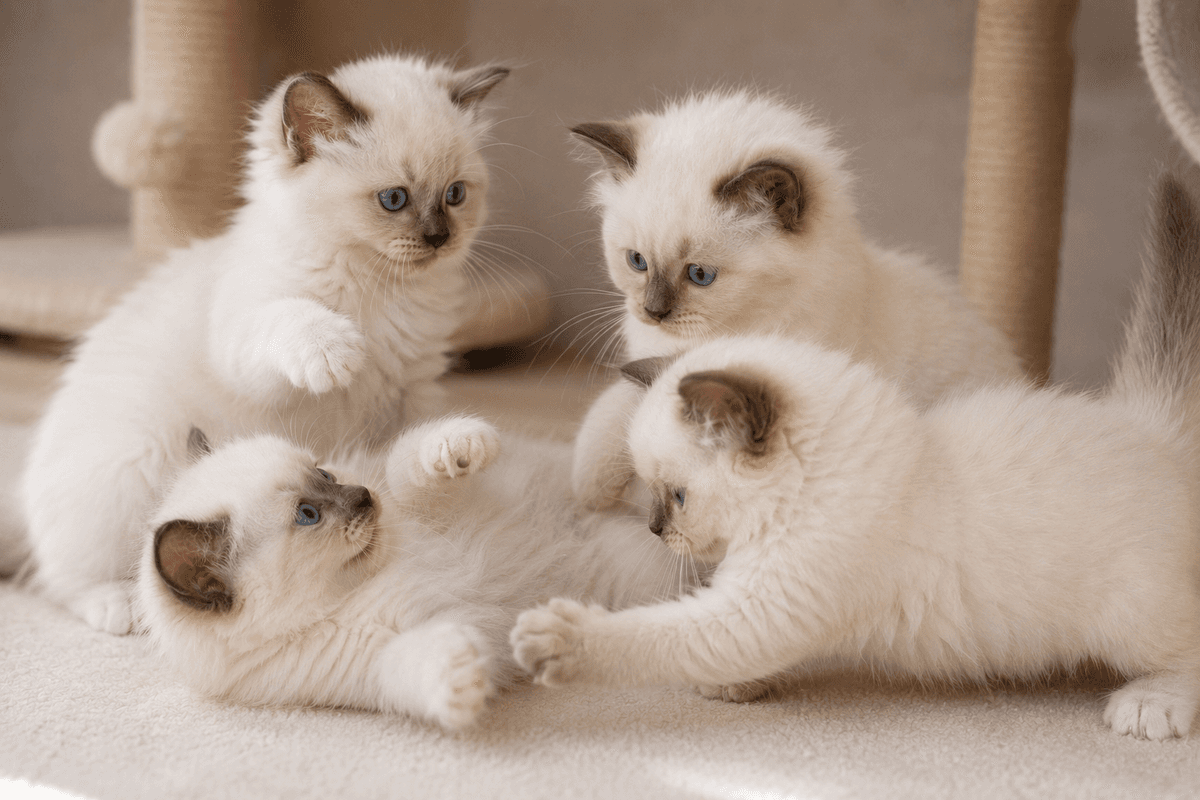
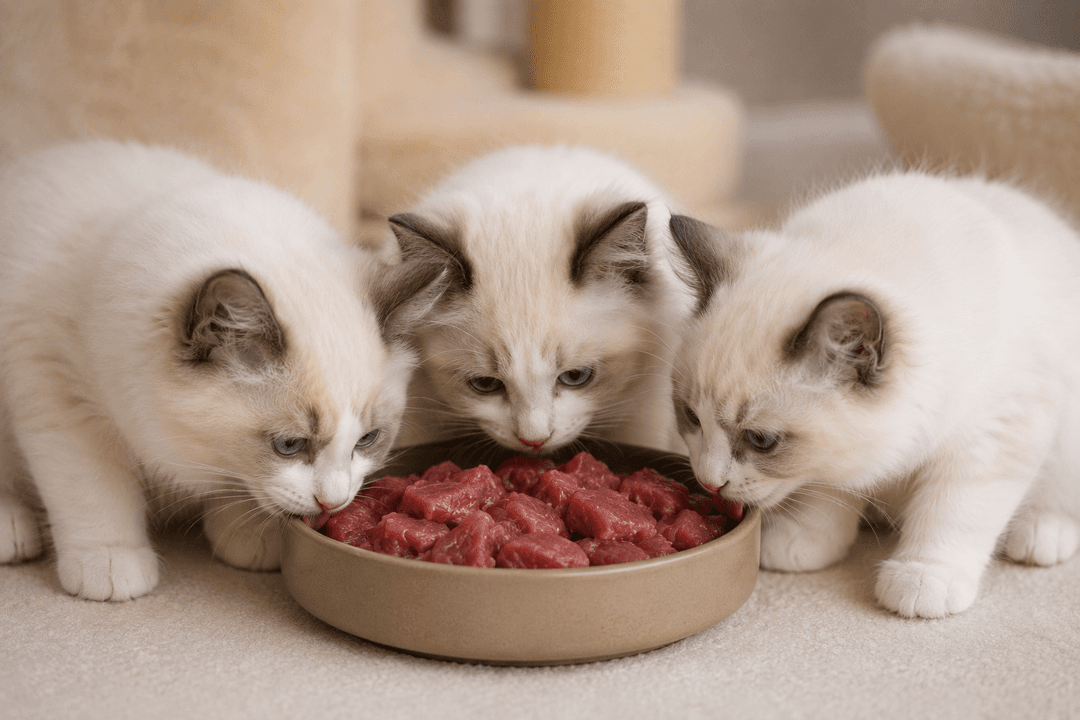
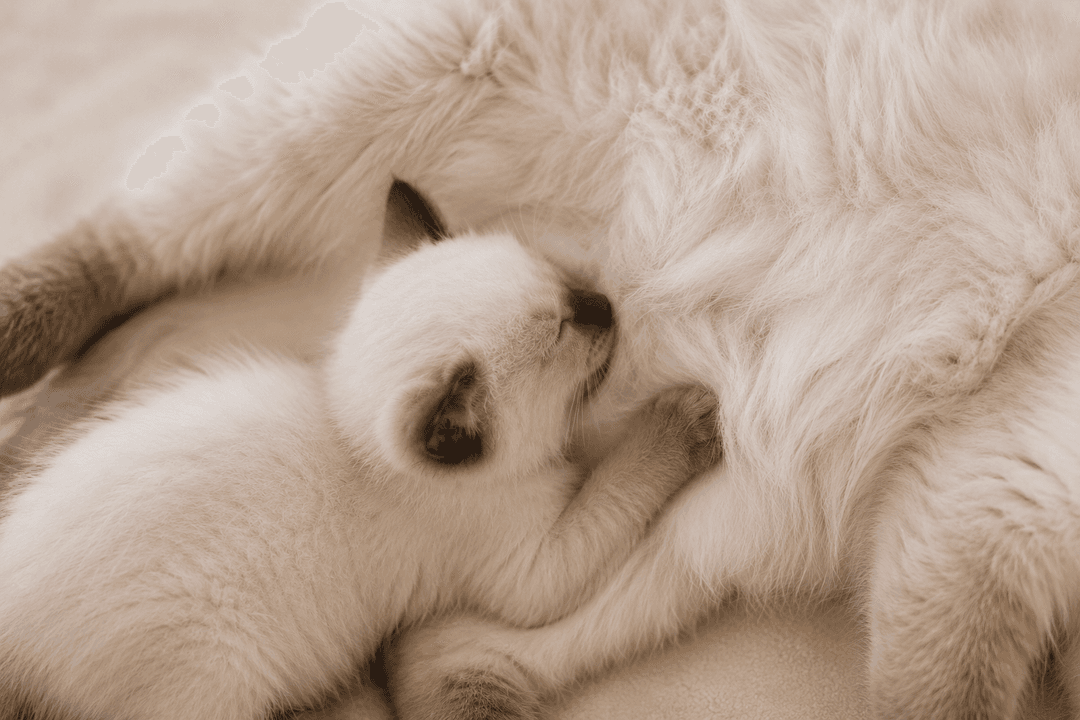
A visual celebration of the Birmadoll and its parent breeds — the Ragdoll and the Sacred Birman.
At a Glance
Birmadoll Quick Facts
Weight
5–9 kg
11–20 lbs
Lifespan
13–17 years
With proper care
Coat Length
Semi-long
Silky, low-mat
Shedding
Moderate
Seasonal increase
Eye Colour
Deep Blue
Breed standard
Activity Level
Moderate
Calm but playful
Kid Friendly
Excellent
Very patient
Dog Friendly
Very Good
Non-aggressive